Established under the EU ETS Directive, the EU Innovation Fund (EU IF) is expected to award approximately €40 billion, based on a carbon price of €75/t [1], to projects that decarbonise European industries. Since becoming operational in 2020, the Fund has awarded close to €16 billion to date [2], supported by 2023 revisions to the EU ETS.
The Fund is designed to support a diverse mix of geographies and sectors across its portfolio, while prioritising large flagship projects that yield tangible results. In practice, this has led to funding being concentrated in a limited number of sectors and Member States, often where abatement costs and administrative burdens are high. However, funding applications continue to be assessed against the key criteria, rather than by sector or location, so achieving the highest score against these criteria remains the most critical determinant of success.
The next EU IF call is now live, featuring a budget uplift to €5.2 billion and a revised mix of targeted sectors and objectives. Alongside a new industrial process heat auction, the 2025 call increases funding for medium-scale and pilot projects. With the deadline for the Net-Zero Technologies (NZT) call set for the 23rd of April 2026 and auction deadlines prior to this, applicants must quickly assess how their projects align with the Fund’s priorities to maximise their chances of success.
Key developments in IF25: €2.3 billion for new auctions
The introduction of a new auction represents a significant extension of targeted support under the EU IF. Explicitly targeting industrial process heat, the auction carries a €1 billion budget to tackle one of the EU’s largest sources of industrial CO2 emissions.
This allocation reflects a considerable commitment. By comparision, the hydrogen pilot auction was awarded €200 million less when first introduced. Now in its third year of operation, the hydrogen auction has received a small budget uplift to €1.3 billion. This has been supplemented by Germany and Spain, which have announced additional national funding through the Auction-as-a-Service (AaaS) mechanism. AaaS enables Member States to provide additional support on top of the EU IF’s commitment, awarded to projects located within their territories that were unsuccessful at EU level but were assessed as highly competitive and award ready.
Deadlines for both auctions are fast approaching, with submissions due by 19th of February. The intense competition observed in previous hydrogen auctions is likely to be replicated in the industrial heat auction, with both sectors covering large quantities of applicable projects across both sectors.
Key Developments in IF25: €2.9 billion for NZT
The EU has allocated a higher available budget to the IF25 NZT call, increasing available funding by €0.5 billion to €2.9 billion, out of a total €5.2 billion envelope including the two auctions. The previous call was nine times oversubscribed, so this budget uplift should enable more projects across Europe to secure support.
Funding allocations have also shifted across sectors and project scales. Clean technology manufacturing has been the largest winner with a €300 million increase, with an additional €100 million assigned to both medium-scale and pilot projects. Furthermore, a ‘Do No Significant Harm’ compliance and a bonus point mechanism for SMEs have been introduced.
The budget for large-scale projects remains unchanged at €1.2 billion, with these projects continuing to command the largest share of funding and requiring complex application processes. Up to IF24 NZT results, the three most-awarded sectors (hydrogen, chemicals and cement and lime) accounted for almost 50% of all Innovation Fund support, despite representing only around 27% of planned greenhouse gas emissions avoidance [3]. These are typically large-scale, heavy industry with high abatement costs, showcasing that the Innovation Fund must address cost-effectiveness while advancing broader European policy objectives.
The IF25 call maintains a focus on industrial competitiveness whilst reinforcing cost-effectiveness and geographical distribution. However, the emphasis on geographical distribution has recently come under scrutiny, with Hydrogen Europe and other stakeholders calling for more emphasis placed upon underrepresented Member States to avoid structural disadvantages [4].
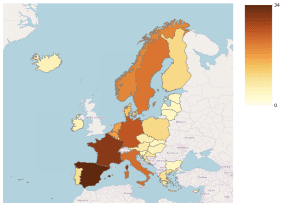
Figure 1. Geographic distribution of number of awarded projects (up to IF24 NZT)
Source: European Commission Innovation Fund Project Portfolio
Figure 1 illustrates the concentration of the number of awarded projects across Member States up to, and including, IF24 NZT. Awarded projects appear concentrated amongst a small number of advanced industrial countries with large hard-to-abate and hydrogen-intensive sectors. In response, the EU has set improving geographical distribution as one of its key objectives for IF25 calls [5]. This is reinforced through increased budgets for pilot projects and targeted measures to support under-represented Member States and small-scale projects.
Despite refinements to Fund objectives, a growing concern since the last call has been the rising administrative burden associated with EU IF applications. In contrast to the Fund’s original intent, applicants increasingly report lengthy and resource-intensive processes.
A recent article by the Financial Times reported that applicants spent up to 3,000 hours preparing submissions, with 77% outsourcing elements of the process to consultants due to internal capacity constraints [6]. Feedback from the EU’s public consultation mirrored these concerns, with calls for “simplified application documentation” emerging as the most common recommendation to support small-scale project participation [7].
Key Takeaways for IF25:
1. Competition will remain intense despite a larger budget
Despite the expanded funding envelope, competition for IF support will only intensify. With recent calls heavily oversubscribed, applicants must clearly differentiate their proposal, demonstrating bankable and credible solutions, that align with wider EU policy objectives and have been rigorously stress-tested to mitigate permitting and delivery risks.
2. Applicants must assess their internal capabilities
Project developers should evaluate their internal capabilities and constraints, identifying critical elements that may require outsourcing to meet increasingly demanding EU standards. Many project developers engage specialist support not only for technical and commercial expertise but to strengthen and maximise the value proposition and narrative coherence.
3. Smaller projects gain prominence but should prepare early
IF25 places greater emphasis on medium- and small-scale projects, supporting the Fund’s objectives of sectoral and geographical diversification. While large-scale projects will continue to secure a substantial share of funding, IF25 represents a clearer pathway for smaller projects to access funding and support for key development milestones. Early preparation will be essential to convert this into successful awards.
Energex has a team of senior practitioners with extensive low-carbon expertise and a proven track record in successful public funding applications. Please contact us at info@energex.partners to discuss our public funding support services.
[1] For reference, the average EU ETS auction price for December 2025 was €83/t
[2] EU grants €2.9bn in ETS innovation funding https://www.argusmedia.com/en/news-and-insights/latest-market-news/2749360-eu-grants-eu2.9bn-in-ets-innovation-funding
[3] European Commission Innovation Fund Project Portfolio
[4] Hydrogen Europe response to Innovation Fund consultation
[5] European Union IF25 call design options
[6] Companies swamped by 3,000 hours of paperwork to tap EU climate funds https://www.ft.com/content/07970763-ad7a-452a-b3f5-82d6d3939ada
[7] European Union IF25 call design options